
18–24 Month Old Sleep Schedule: Wake Windows, 1–2 Naps & Toddler Sleep

If your toddler is between 18 and 24 months old, you may feel like sleep should be pretty predictable by now.
And sometimes it is.
Your toddler may be sleeping consistently through the night.
They may be taking one predictable nap.
Meals and snacks may finally have a rhythm.
Bedtime may feel easier than it did during infancy.
But this age can also bring an entirely new set of sleep questions.
Maybe your 18 month old seems ready for one nap some days—but absolutely cannot make it on other days.
Maybe your toddler has started waking at 5:00am.
Maybe one nap worked beautifully for a few weeks and suddenly isn’t working anymore.
Maybe your toddler is sleeping wonderfully at daycare but struggling at home.
Or maybe nighttime sleep suddenly changed and you’re wondering whether the nap is now too long.
Between 18 and 24 months old, sleep continues to evolve.
Wake periods become longer.
Daytime sleep gradually decreases.
Most toddlers eventually settle consistently into one nap.
But that transition doesn’t always happen in a perfectly straight line.
And that’s important.
Your toddler does not have to be completely finished with two naps just because they turned 18 months old.
For some toddlers, especially those dealing with an early start to the day or those who simply aren’t ready to consistently tolerate a one-nap schedule, continuing to use two naps — or vacillating between one nap and two naps — can be helpful even as they move toward 21 months old.
The goal isn’t getting your toddler onto one nap as quickly as possible.
The goal is protecting consistent nighttime sleep while gradually allowing daytime sleep to evolve.
Let’s talk about what that can look like.
The Short Answer: A good 18–24 month old sleep schedule is not necessarily the same schedule every single day.
Most toddlers during this stage are moving toward:
- ✔️ One consistent nap
- ✔️ Longer periods of awake time
- ✔️ Gradually less daytime sleep
- ✔️ A predictable bedtime
- ✔️ Consistent nighttime sleep
- ✔️ Regular meals and snacks, with milk still playing an important role for many toddlers
But some toddlers still benefit from two naps on certain days.
This is especially true during the transition to one nap, after an unusually early morning, or when your toddler simply isn’t ready to comfortably make it through the day with one nap yet.
You may even find yourself alternating:
One nap one day.
Two naps another day.
That’s okay.
The nap transition doesn’t have to happen overnight.
The Full Feedings approach is to protect nighttime sleep rather than forcing your toddler into a schedule they aren’t ready to maintain consistently.
18–24 Month Old Sleep Guidelines
Wake Windows = Around 5 hours. Earlier starts of day may require longer wake windows.
Daytime Feeds = Regular meals and snacks, with milk as needed.
Bottle Feeding Guidelines = Up to 24 oz of cow’s milk daily, gradually weaning down as appropriate.
Number of Naps = 1–2 naps. Transitioning toward 1 nap, with 2 naps as needed until around 21 months old.
Nap Length = 1.5–2 hours. Gradually decreasing from 2 hours at 18 months to 1.5 hours by 24 months.
Bedtime = 6:30–7:00 PM. Move bedtime earlier when naps are short or daytime sleep is insufficient.
Dreamfeed = Not typically needed at this age.
Night Feeds = Not typically needed. If your toddler still needs milk overnight, evaluate daytime nutrition and milk intake.
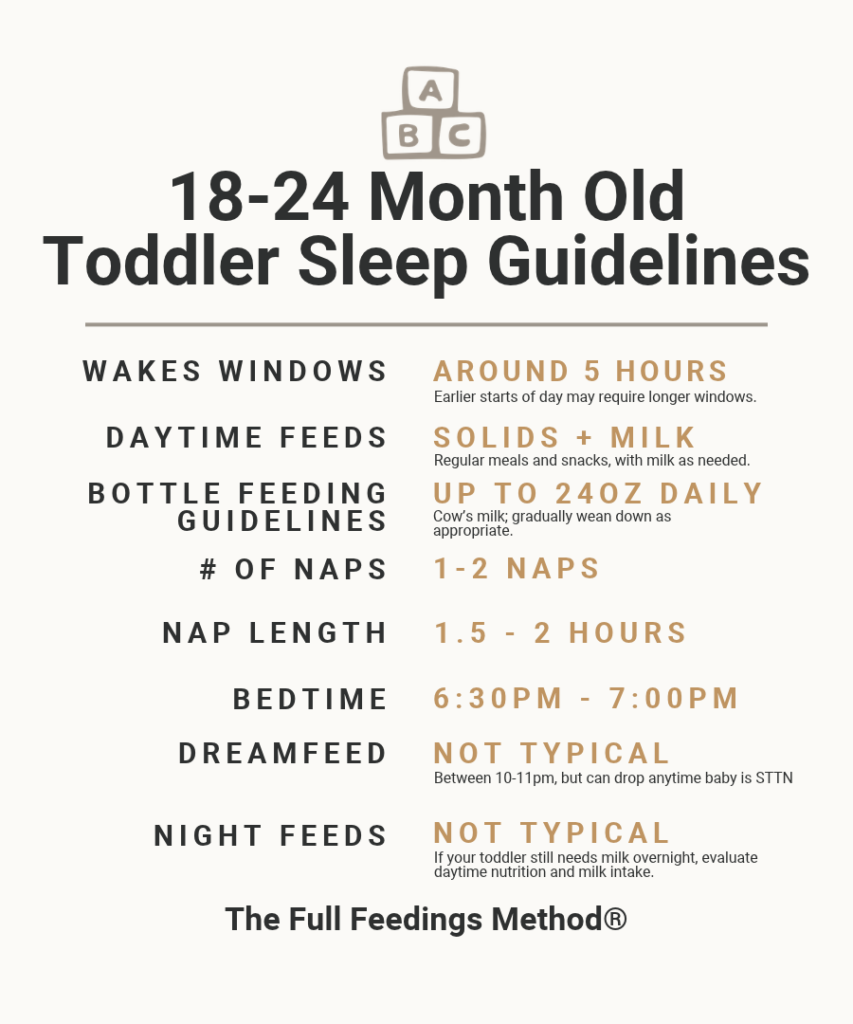
These are general guidelines.
Every toddler develops differently, and feeding, growth, daycare schedules, medical history, and your pediatrician’s recommendations should always be considered.
Why Sleep Changes Between 18 and 24 Months
Toddlerhood is busy.
Really busy.
Your toddler may be:
- ✔️ running
- ✔️ climbing
- ✔️ talking more
- ✔️ learning new words every day
- ✔️ becoming increasingly independent
- ✔️ developing very strong opinions
- ✔️ eating a wider variety of foods
- ✔️ attending daycare or preschool
- ✔️ testing boundaries
Their sleep needs are changing at the same time.
One of the biggest changes during this period is that daytime sleep gradually decreases. Rather than making one dramatic change to your toddler’s nap schedule, daytime sleep should be slowly reduced over these six months as their sleep needs evolve, helping to protect consistent nighttime sleep.
And that’s the piece I want parents to understand.
You don’t need to suddenly slash a nap because your toddler reached a particular age.
Instead, daytime sleep can be lessened slowly over time as your toddler demonstrates that they need less of it.
If nighttime sleep is going beautifully, there may be nothing to change.
If nighttime sleep begins changing, daytime sleep is one of the pieces we can evaluate.
But we make those changes gradually.
Toddler sleep usually responds much better to thoughtful adjustments than dramatic schedule overhauls.
 Ready for better toddler sleep?
From 12 months through 4 years, The Full Feedings Method® Toddler Sleep Program helps you navigate changing wake windows, nap schedules, bedtime struggles, and night wakings with age-appropriate guidance.
No cry-it-out. Just a responsive approach to healthy, consistent sleep.


The Transition From 2 Naps to 1 Isn’t Always Linear
This is probably the most important thing I want parents of 18 month olds to understand.
The transition to one nap doesn’t have to happen all at once.
Your toddler might do beautifully with one nap on Monday.
Then wake extremely early Tuesday and desperately need two naps.
Wednesday might be another successful one-nap day.
Thursday?
Two naps again.
That doesn’t mean you’re confusing your toddler.
It doesn’t mean the transition failed.
It means you’re responding to the day your toddler actually had.
The transition from two naps to one doesn’t have to happen overnight. Toddlers can alternate between one and two naps as needed while adjusting to longer wake windows. An occasional second nap can also be helpful after an unusually early start to the day, allowing your toddler to reset their routine while avoiding overtiredness and protecting consistent nighttime sleep.
In our approach, that flexibility can continue up to around 21 months old when needed, particularly if your toddler:
- ✔️ started the day unusually early
- ✔️ isn’t consistently ready for one nap
- ✔️ becomes extremely overtired trying to make it to one nap
- ✔️ has had an unusually active day
- ✔️ simply sleeps better at night when two naps are occasionally used
The important piece is that two naps shouldn’t become an excuse to add unlimited daytime sleep.
We’re still protecting nighttime sleep.
We’re simply using naps strategically while your toddler develops the ability to comfortably manage one consistent nap.
What If My Toddler Wakes Really Early?
This is one of the situations where flexibility becomes incredibly valuable.
Let’s say your toddler normally starts their day at a reasonable time but suddenly wakes very early.
Trying to force your usual one-nap schedule can create an extremely long stretch of awake time.
By the time nap arrives, your toddler may already be overtired.
And then you may end up with:
- ✔️ a difficult nap
- ✔️ a short nap
- ✔️ an exhausted afternoon
- ✔️ a bedtime battle
- ✔️ another early morning
That’s how an early waking pattern can sometimes perpetuate itself.
Instead of forcing one nap no matter what, an occasional second nap can be used strategically to help your toddler get through the day and work back toward their normal rhythm. This reset approach is specifically built into the 18–24 Month Full Feedings guidance.
This is why I don’t love rigid toddler schedules.
The schedule should support your toddler.
Your toddler shouldn’t have to survive the schedule.
How Long Should an 18–24 Month Old Stay Awake?
By this age, toddlers can comfortably stay awake much longer than they could during infancy.
Between 18 and 24 months old, most toddlers do well with wake windows of approximately 5 hours to 5 hours 15 minutes, although an earlier start to the day may occasionally require longer periods of awake time.
But I don’t want parents obsessing over hitting an exact minute.
Instead, look at the entire day.
Is your toddler falling asleep reasonably well?
Are naps restorative?
Is bedtime going smoothly?
Are they consistently sleeping well overnight?
Are early mornings becoming a pattern?
Those outcomes tell us much more than whether you hit a wake window perfectly.
And remember that awake time at this age includes a lot.
Meals.
Snacks.
Outdoor play.
Running.
Climbing.
Reading.
Daycare.
Errands.
Learning.
Baths.
Connection with you.
Toddlers are physically and mentally busy.
Two toddlers can technically have the same wake window and experience that time very differently.
That’s another reason the Full Feedings approach looks at the whole day, rather than treating one number on a schedule as the answer to every sleep problem.
Should I Shorten My Toddler’s Nap?
Maybe.
But slowly.
Between 18 and 24 months, your toddler will gradually need less daytime sleep. The member guide contains the detailed progression for how that reduction happens across this period.
For the purposes of understanding the principle, here’s what matters:
Nap length should gradually lessen as your toddler gets older and their sleep needs change.
Not overnight.
Not because another toddler the same age takes a shorter nap.
And not because someone on the internet told you every 20 month old should nap for exactly X amount of time.
If your toddler is:
- ✔️ sleeping consistently through the night
- ✔️ going to bed well
- ✔️ waking at a reasonable time
- ✔️ taking a restorative nap
then you may not need to change anything.
If nighttime sleep starts becoming less consistent, bedtime becomes increasingly difficult, or early mornings begin appearing, then daytime sleep is one of the things worth evaluating.
The key is making small, gradual adjustments rather than dramatically cutting daytime sleep.
Because the opposite problem can happen, too.
Take away too much daytime sleep too quickly and you can create an overtired toddler—which can make nighttime sleep harder, not easier.
This stage is about finding the balance between enough daytime sleep to keep your toddler well rested and not so much that it begins competing with nighttime sleep.
And that balance will continue changing as your toddler approaches age two.
What About Daycare or School Naps?
Daycare can make toddler sleep feel especially complicated.
Maybe your toddler naps beautifully at home but naps later at school.
Maybe the daycare nap is longer than you’d normally offer.
Or maybe you simply don’t have control over when your toddler sleeps during the week.
That’s okay.
You do not need to create a battle with daycare over achieving a perfect nap schedule.
The Full Feedings approach is to focus on maintaining an age-appropriate routine when you can control it, particularly on non-school days. If your toddler naps later or longer at daycare or school than you would typically recommend at home, that’s okay. Focus on maintaining an age-appropriate nap schedule on the days you have more flexibility to help protect consistent nighttime sleep.
Think of your home routine as your opportunity to keep reinforcing the sleep rhythm you’re working toward.
If daycare sleep is working and your toddler is still sleeping consistently overnight, there may be nothing to fix.
If nights begin changing, then look at the entire picture:
- ✔️ How much daytime sleep is your toddler getting?
- ✔️ How late is the nap ending?
- ✔️ Is bedtime becoming difficult?
- ✔️ Are early mornings appearing?
- ✔️ Is the daycare schedule very different from the home schedule?
You may not be able to change the daycare nap.
But you can make thoughtful adjustments around it.
The goal is not a perfect schedule seven days a week.
The goal is consistent nighttime sleep.
Why an Early Bedtime Can Still Be Your Best Friend
Early bedtime isn’t just for babies.
It can be incredibly useful during the toddler years, especially while your child is transitioning from two naps to one.
Maybe your toddler:
- ✔️ woke unusually early
- ✔️ took a short nap
- ✔️ refused a nap
- ✔️ had a very active day
- ✔️ needed two naps and the day unfolded differently than usual
- ✔️ simply seems exhausted
On those days, don’t assume you need to keep your toddler awake until their usual bedtime.
An earlier bedtime can help compensate when daytime sleep didn’t go as planned. The 18–24 Month Guide specifically incorporates an earlier bedtime when a toddler hasn’t gotten the daytime sleep they need.
This is particularly important during the one-nap transition.
Parents sometimes become so focused on maintaining the new one-nap schedule that they accidentally create an overtired toddler.
They think:
“If I put them to bed early, they’ll wake early.”
So they push bedtime later.
But keeping an already tired toddler awake longer doesn’t necessarily create a later morning.
Sometimes it creates an even more overtired child who has a harder time sleeping consistently.
If the day didn’t go as planned, bedtime can be one of your most useful tools.
Milk Still Matters During the Toddler Years
By 18–24 months old, your toddler is eating real meals.
Breakfast.
Lunch.
Dinner.
Snacks.
They may have very strong opinions about all of them.
And milk is no longer your child’s primary source of nutrition in the way breast milk or formula was during infancy.
But that doesn’t mean milk suddenly becomes irrelevant.
From 18-24 months we still recommend to incorporate milk into your toddler’s daily feeding routine while gradually adjusting it alongside solid food intake.
This is another area where I don’t encourage parents to rush.
If your toddler is drinking more milk than you ultimately want them to, you can gradually work toward less.
But just like nap transitions, feeding transitions don’t have to happen overnight.
And if you’re changing milk intake at the same time you’re changing naps, bedtime, daycare, or another major part of the routine, it can become difficult to know which change is affecting sleep.
Gradual transitions make it much easier to see what your toddler actually needs.
Can Solids Affect Toddler Sleep?
Absolutely.
We talk about this throughout infancy, but it doesn’t suddenly stop being relevant after the first birthday.
Toddlers can be unpredictable eaters.
One day they eat everything.
The next day they survive on what appears to be three blueberries and air.
They may love a food on Monday and refuse to acknowledge its existence by Wednesday.
That’s toddlerhood.
But nutrition and sleep are still connected.
If your toddler isn’t getting enough to eat during the day, hunger can affect sleep.
This can sometimes show up as:
- ✔️ night waking
- ✔️ early morning waking
- ✔️ difficulty settling
- ✔️ asking for milk overnight
- ✔️ suddenly seeming ravenous first thing in the morning
This doesn’t mean every sleep disruption is caused by hunger.
It means feeding is one of the ingredients we consider.
If nighttime sleep suddenly changes, ask yourself:
Has anything changed with eating or milk intake?
Maybe your toddler has become pickier.
Maybe milk was reduced quickly.
Maybe they’re too busy to sit down and eat much during the day.
Maybe daycare meals are different.
Maybe they’re going through a phase where their appetite has temporarily changed.
Before assuming you have a sleep problem, look at feeding, too.
Meals, Snacks, Milk & Sleep Work Together
During infancy, we talked constantly about protecting full daytime milk feeds.
Toddler feeding looks different.
Your toddler’s day is now increasingly built around meals and snacks, with milk fitting into the larger nutritional picture.
But the underlying Full Feedings principle remains the same:
We want your child getting the nutrition they need during the day.
If your toddler barely eats dinner, then wakes overnight asking for milk, that’s information.
If your toddler starts waking early at exactly the same time you dramatically reduce milk, that’s information.
If your toddler is eating well, drinking appropriately, sleeping through the night, and thriving?
That’s information, too.
You don’t have to change something simply because your child reached another age milestone.
Look at your child.
Look at the day.
Look at the night.
Then make changes based on what’s actually happening.
 Fighting naps, bedtime, or night wakings?
Your toddler’s sleep needs are constantly changing — but figuring out what to adjust shouldn’t be a guessing game.
The Full Feedings® Toddler Sleep Program gives you step-by-step guidance for naps, wake windows, bedtime, and nighttime sleep from 12 months through 4 years.

Is the 18 Month Sleep Regression Real?
If you’ve searched for toddler sleep online, you’ve probably encountered the phrase:
“18 month sleep regression.”
And yes, sleep can absolutely change around this age.
But I don’t want “regression” to become the explanation for every difficult night.
Eighteen months is also right around the time when a lot is changing.
Your toddler may be transitioning toward one nap.
Wake periods are getting longer.
Daytime sleep needs are gradually changing.
Language is exploding.
Independence is growing.
Separation awareness can become stronger.
Feeding preferences may change.
Daycare routines may change.
That’s a lot happening at once.
So if your toddler suddenly stops sleeping as well, don’t automatically assume you simply have to wait out a regression.
Instead, ask:
- ✔️ Are we pushing the one-nap transition too quickly?
- ✔️ Does my toddler still need two naps occasionally?
- ✔️ Has daytime sleep changed?
- ✔️ Is bedtime appropriate for the day we actually had?
- ✔️ Has eating or milk intake changed?
- ✔️ Are early mornings creating wake periods that are simply too long?
- ✔️ Has something changed at daycare?
Often, there is something in the day worth examining.
And sometimes the answer is surprisingly simple.
What If My 18 Month Old Isn’t Ready for One Nap?
Then your toddler isn’t ready.
That’s okay.
Age is a guideline—not a deadline.
Some toddlers may still need two naps as they enter this stage, and the transition to one nap doesn’t have to happen all at once.
I would rather see you alternate between one and two naps when needed — even up to around 21 months old — than force a one-nap schedule that repeatedly compromises nighttime sleep.
This can be particularly useful when your toddler has an early start to the day.
Maybe one nap works beautifully when your toddler wakes at their normal time.
But after an extremely early morning?
The same schedule might require your toddler to stay awake far longer than they’re ready for.
That’s where flexibility matters.
A second nap can sometimes help reset the day rather than allowing overtiredness to snowball into another difficult night and another early morning.
You aren’t “going backward.”
You’re using sleep strategically.
As your toddler becomes truly ready for one nap, you’ll find yourself needing that second nap less and less.
Eventually, one nap becomes the consistent rhythm.
You don’t have to force it to get there.
What If My Toddler Is Fighting the Second Nap?
This is where things become a little more nuanced.
Refusing the second nap once does not automatically mean your toddler is finished with two naps.
Neither does refusing it twice.
Look for a pattern.
How does your toddler handle the rest of the day without it?
How does bedtime go?
How is nighttime sleep?
What happens the next morning?
A toddler can absolutely refuse a nap because they’d rather be playing.
They’re toddlers.
They have plans.
What matters is whether their sleep as a whole tells you they’re ready for the change.
If one nap consistently supports:
- ✔️ a happy, well-rested toddler
- ✔️ a manageable day
- ✔️ a smooth bedtime
- ✔️ consistent nighttime sleep
then you’re probably moving in the right direction.
If one nap repeatedly results in:
- ✔️ an exhausted afternoon
- ✔️ bedtime struggles
- ✔️ new night waking
- ✔️ very early mornings
then your toddler may need more time.
This is why I don’t recommend treating the transition as a single event.
It’s a process.
What Happens to Nap Length Between 18 and 24 Months?
It gradually decreases.
That’s really the most important thing parents need to understand.
You do not need to wake up one morning and dramatically shorten your toddler’s nap because they reached a particular month.
Instead, daytime sleep slowly lessens as your toddler moves toward age two. That’s also how the progression is structured in the Full Feedings 18–24 Month Guide.
Watch nighttime sleep.
Watch bedtime.
Watch morning wake time.
Those are valuable clues.
If everything is working beautifully, you don’t need to constantly tinker with the schedule.
As your toddler gets older and begins needing a little less daytime sleep, you can gradually lessen the nap.
Small changes.
Then observe.
That’s very different from suddenly cutting a large amount of daytime sleep because your toddler had one rough night.
Our goal is always the same:
Enough daytime sleep to keep your toddler rested.
But not so much daytime sleep that it begins compromising consistent nighttime sleep.
That balance will gradually shift throughout this stage.
And that’s exactly what we want.
What If My 18–24 Month Old Suddenly Starts Waking at Night?
If your toddler was consistently sleeping through the night and suddenly starts waking again, it can be incredibly frustrating.
Especially when you thought sleep was finally something you didn’t have to think about anymore.
But before assuming your toddler has developed a sleep problem, look at the entire day.
Between 18 and 24 months old, nighttime sleep can be affected by:
- ✔️ the transition from two naps to one
- ✔️ too much or too little daytime sleep
- ✔️ over tiredness
- ✔️ an early start to the day
- ✔️ bedtime timing
- ✔️ changes in eating or milk intake
- ✔️ daycare schedules
- ✔️ developmental milestones
- ✔️ illness or teething
This is why I don’t immediately focus on the night.
I want to know:
What changed during the day?
Did you recently move completely to one nap?
Did you start shortening the nap?
Has your toddler started waking earlier?
Has bedtime drifted later?
Have eating habits changed?
Did daycare change their schedule?
Those details matter.
Sometimes nighttime waking is your first clue that something during the day needs adjusting.
What If My Toddler Is Waking at 5:00am?
Early morning waking can be one of the most frustrating toddler sleep challenges.
And it can quickly create a cycle.
Your toddler wakes extremely early.
Now the first wake period becomes unusually long.
You try to hold out until the normal nap.
Your toddler becomes overtired.
The nap doesn’t go well.
The afternoon becomes difficult.
Bedtime becomes difficult.
And then…
Another early morning.
This is exactly why I don’t believe you should force one nap every single day simply because your toddler has reached a particular age.
An unusually early start to the day may require a more flexible approach to naps. Temporarily adding a second nap can help prevent overtiredness, reset your toddler’s routine, and gradually work toward a later start to the day.
If your toddler has an unusually early start, using two naps that day may help you get back toward your normal rhythm.
And depending on your toddler’s readiness, vacillating between one and two naps can remain useful up to around 21 months old.
That doesn’t mean adding unlimited daytime sleep.
It means strategically using the second nap when your toddler needs it.
The goal is always to get back to a normal start to the day and protect nighttime sleep.
What If One Nap Suddenly Stops Working?
This is important because nap transitions aren’t always linear.
Your toddler may do beautifully with one nap for several days—or even several weeks—and then suddenly struggle.
That doesn’t necessarily mean the transition failed.
Look at what else is happening.
Maybe your toddler:
- ✔️ woke earlier than usual
- ✔️ had several short naps in a row
- ✔️ is going through a developmental change
- ✔️ has been especially active
- ✔️ hasn’t been eating as well
- ✔️ has had a schedule change at daycare
- ✔️ simply needs a little more sleep right now
Toddler sleep needs aren’t identical every single day.
If your toddler needs a second nap occasionally, you haven’t ruined the one-nap transition.
Use the ingredients you have.
Then return to one nap when your toddler can comfortably manage it again.
Eventually, one nap will become the consistent routine.
There is no benefit to forcing it before your toddler is ready.
How Do I Know If My Toddler Is Ready for One Nap?
Don’t decide based on age alone.
Instead, look at what happens when your toddler takes one nap.
A toddler who is truly ready for one nap should gradually be able to tolerate the longer periods awake without nighttime sleep consistently falling apart.
Ask yourself:
- ✔️ Can my toddler comfortably make it to the nap?
- ✔️ Is the nap restorative?
- ✔️ Can my toddler comfortably make it from nap to bedtime?
- ✔️ Is bedtime going reasonably well?
- ✔️ Is nighttime sleep still consistent?
- ✔️ Is morning wake time remaining consistent?
Those are much more useful questions than:
“My toddler is 18 months old. Shouldn’t we be on one nap?”
If one nap works, wonderful.
If your toddler still needs two naps occasionally, that’s okay too.
The transition can be gradual.
What If My Toddler’s Nap Is Getting Too Long?
As your toddler moves from 18 toward 24 months old, daytime sleep gradually decreases. The Full Feedings Guide uses a gradual progression across this entire stage rather than one abrupt reduction.
You may begin noticing clues that your toddler needs a little less daytime sleep.
Perhaps bedtime suddenly takes much longer.
Maybe nighttime sleep becomes less consistent.
Maybe morning starts getting earlier.
That’s when I would evaluate the nap.
But don’t overcorrect.
You don’t need to dramatically shorten daytime sleep after one difficult bedtime.
Lessen nap length slowly.
Make a small adjustment.
Give your toddler time to respond.
Then evaluate nighttime sleep again.
As your toddler approaches age two, you may continue gradually decreasing daytime sleep based on how nighttime sleep is going.
The exact progression is less important here than understanding the principle:
Daytime sleep should support nighttime sleep—not compete with it.
Can an 18–24 Month Old Sleep Through the Night?
Toddlers between 18 and 24 months old are developmentally capable of sleeping consistently through the night.
If your toddler was previously sleeping through and suddenly isn’t, I would look for what changed before assuming they’ve simply stopped being a good sleeper.
Consider:
- ✔️ naps
- ✔️ wake time
- ✔️ bedtime
- ✔️ early morning waking
- ✔️ feeding
- ✔️ milk intake
- ✔️ daycare
- ✔️ development
If your toddler wakes occasionally because they’re sick, teething, frightened, or genuinely need you, respond to them.
Consistent nighttime sleep doesn’t mean your toddler will never need you again.
It means we’ve created a daytime routine that gives them the best opportunity to get the nighttime sleep they need.
Common 18–24 Month Old Sleep Struggles
My 18 Month Old Isn’t Ready for One Nap
That’s okay. Some toddlers need more time. You can continue using two naps when needed or alternate between one- and two-nap days while your toddler develops the ability to consistently manage one nap. In the Full Feedings approach, that flexibility can be useful up to around 21 months old, especially after an early start to the day.
My Toddler Was Doing One Nap but Suddenly Needs Two Again
An occasional two-nap day doesn’t mean you’re going backward. If your toddler woke unusually early or clearly cannot comfortably manage the day on one nap, a second nap can be used strategically to help reset the routine.
My Toddler Is Waking at 5:00am
Look at the entire day. Early waking can be related to overtiredness, nap timing, daytime sleep, bedtime, feeding, or a one-nap transition that your toddler isn’t consistently ready to maintain. An occasional two-nap day may help after a particularly early start.
My Toddler Suddenly Started Waking Overnight
Before assuming it’s a regression, look at naps, daytime sleep, feeding, bedtime, early mornings, daycare, and recent developmental changes.
My Toddler Is Fighting Bedtime
Bedtime resistance doesn’t automatically mean bedtime should move later. Look at the nap, total daytime sleep, wake time, activity, and the overall routine before changing bedtime.
My Toddler Is Fighting Their Nap
Toddlers have opinions. One refused nap doesn’t necessarily mean the nap is no longer needed. Look for a consistent pattern and, most importantly, watch what happens to nighttime sleep.
My Toddler Naps Differently at Daycare
That’s okay. If you don’t control the daycare nap, focus on an age-appropriate routine on the days you do control. The Full Feedings 18–24 Month Guide specifically accommodates later daycare or school naps while encouraging families to return to their age-appropriate routine on non-school days.
My Toddler’s Nap Is Affecting Nighttime Sleep
As toddlers approach age two, they gradually need less daytime sleep. If nighttime sleep begins changing, daytime sleep is one factor to evaluate. Reduce nap length slowly rather than making a dramatic change.
My Toddler Isn’t Eating Well and Started Waking at Night
Feeding still matters. Toddler appetites can fluctuate, but if nighttime sleep changes alongside a significant change in eating or milk intake, look at the entire nutritional picture rather than treating the waking as an isolated sleep problem.
 Frequently Asked Questions
What is a good sleep schedule for an 18–24 month old?
A good 18–24 month old sleep schedule usually includes one nap, longer age-appropriate periods of awake time, gradually decreasing daytime sleep, regular meals and snacks, and a consistent bedtime. Some toddlers may still benefit from two naps occasionally while transitioning.
How many naps should an 18 month old take?
Many 18 month olds are transitioning toward one nap, but not every toddler is ready at exactly the same age. Some still benefit from two naps, and alternating between one- and two-nap days can be helpful during the transition.
Can my 19 or 20 month old still take two naps?
Yes. If your toddler isn’t consistently ready for one nap, or an unusually early morning makes one nap difficult, two naps can still be used when needed. The goal is protecting nighttime sleep rather than forcing the one-nap transition.
Can I alternate between one nap and two naps?
Yes. The transition doesn’t have to happen overnight. In the Full Feedings approach, vacillating between one and two naps can be useful up to around 21 months when your toddler needs it, particularly after an early start to the day.
When should my toddler consistently be on one nap?
Rather than choosing a specific birthday, look at your toddler’s readiness. When they can comfortably manage the day with one restorative nap while maintaining consistent nighttime sleep, one nap can naturally become the regular routine.
How long should an 18–24 month old nap?
Nap needs gradually decrease between 18 and 24 months old. Rather than focusing on one exact nap length, look at how daytime sleep is affecting bedtime, nighttime sleep, and morning wake time. If daytime sleep needs to be reduced, lessen nap length slowly.
How long should an 18–24 month old stay awake?
Toddlers this age can tolerate much longer periods awake than younger babies. Wake periods generally increase throughout this stage, but the appropriate amount depends on age, morning wake time, naps, and how your toddler is sleeping overnight.
Why is my 18 month old suddenly waking at night?
Night waking can be related to the transition to one nap, over tiredness, too much or too little daytime sleep, early waking, bedtime timing, feeding changes, daycare, illness, teething, or developmental milestones.
Why is my toddler suddenly waking at 5:00am?
Early waking can be related to over tiredness, nap timing, daytime sleep, bedtime, feeding, developmental changes, or the one-nap transition. If an early start creates an excessively long day, an occasional second nap can sometimes help reset the routine.
Should I shorten my toddler's nap if bedtime is getting difficult?
Possibly, but make changes gradually. If bedtime or nighttime sleep has consistently changed, daytime sleep is one factor worth evaluating. Rather than dramatically cutting the nap, lessen it slowly and observe how your toddler responds.
What if daycare has a different nap schedule?
That’s okay. You may not be able to control the daycare nap. Focus on maintaining your age-appropriate routine on non-school days and adjust the parts of the day you can control.
Can food or milk affect toddler sleep?
Yes. If your toddler’s eating habits or milk intake change significantly and sleep changes at the same time, feeding is worth evaluating. Toddler sleep is still influenced by the entire day—not only naps and bedtime.
Can an 18–24 month old sleep through the night?
Toddlers this age are capable of consistent nighttime sleep. If a toddler who previously slept well suddenly begins waking, look at daytime sleep, wake time, bedtime, feeding, early mornings, and developmental changes before assuming the night itself is the problem.
Ready for a toddler sleep plan that grows with your child?
The Full Feedings Method® gives you the step-by-step guidance behind nap transitions, wake time, early mornings, feeding, bedtime, and consistent nighttime sleep — so you know exactly what to adjust as your toddler grows.
Final Thoughts
The 18–24 month stage isn’t about getting your toddler onto one perfect schedule as quickly as possible.
It’s about protecting nighttime sleep while daytime sleep gradually evolves.
For many toddlers, one nap will become the normal routine during this stage.
But that transition may not happen in a straight line.
Some days may need one nap.
Some days may need two.
An early start to the day may change what your toddler needs.
And if your toddler isn’t consistently ready for one nap, there’s no reason to force it simply because they’ve reached a certain age.
In the Full Feedings approach, using two naps when needed—or vacillating between one and two naps—can remain a useful tool up to around 21 months old.
Then, as your toddler grows, daytime sleep will naturally need to lessen.
Do it gradually.
You don’t need to dramatically shorten a nap overnight.
You don’t need to change a routine that’s working.
And you don’t need to chase every sleep disruption with a brand-new schedule.
Instead, look at the whole day.
Naps matter.
Wake time matters.
Bedtime matters.
Feeding still matters.
And consistency at night tells us a tremendous amount about whether those pieces are working together.
Toddler sleep is different from infant sleep.
There are fewer month-to-month changes and more gradual adjustments.
And that’s exactly why understanding the why behind your toddler’s sleep becomes so important.
When you know what to look for, you can make small changes when they’re needed, protect what is already working, and help your toddler continue getting the healthy, consistent nighttime sleep they need.

