
12–18 Month Sleep Schedule: Wake Windows, 2 Naps, Milk & the One-Nap Transition

Your baby’s first birthday is a huge milestone.
Over the past year, you’ve likely watched them grow from a sleepy newborn into a curious, active little person who is crawling, walking, talking, exploring, and developing a personality all their own.
But while turning one is exciting, it also seems to come with a flood of advice.
“It’s time for one nap.”
“Get rid of the bottle.”
“Switch to cow’s milk.”
“They should be eating mostly solids now.”
“Push bedtime later.”
For many families, it can feel like everything is supposed to change overnight.
At Full Feedings®, we see things differently.
The second year of life isn’t about rushing from one milestone to the next. It’s about making gradual, thoughtful adjustments while continuing to support your toddler’s sleep, nutrition, and development.
For the purpose of this blog, a 12–18 month old refers to toddlers between their first birthday and approximately 18 months of age.
During these months, your toddler will likely become more independent, more active, and more communicative — but many of their sleep needs remain surprisingly similar.
Most toddlers continue benefiting from two naps for much of this stage, daytime sleep gradually decreases, wake windows slowly lengthen, and many families begin navigating transitions involving milk, bottles, cups, and eventually one nap.
The key word is gradually. There is no prize for making every transition at once.
In this guide, we’ll walk through what healthy sleep typically looks like between 12 and 18 months, how sleep changes throughout this stage, why many toddlers still benefit from two naps, how to approach milk after age one, and how to know when your toddler is truly ready to transition to one nap.
The Short Answer: A healthy 12–18 month sleep schedule usually includes:
- ✔️ Two naps for as long as they continue working
- ✔️ Age-appropriate wake windows
- ✔️ Gradually decreasing daytime sleep
- ✔️ Regular meals and milk
- ✔️ A consistent bedtime routine
- ✔️ A gradual transition to one nap when your toddler is developmentally ready
One of the biggest misconceptions about toddler sleep is that your child’s first birthday changes everything.
In reality, most toddlers don’t need a completely different routine at 12 months, 13 months, 14 months, 15 months, 16 months, or even 17 months.
Instead, sleep changes happen slowly.
Wake windows gradually lengthen. Daytime sleep gradually decreases. Nap #1 often becomes shorter while Nap #2 continues providing restorative sleep. Milk slowly becomes less important as solids become a larger part of your toddler’s diet—but there is no rush to eliminate it if your toddler still needs it.
Rather than chasing milestones, focus on protecting the routines that are already supporting healthy sleep and good nutrition.
12–18 Month Sleep Guidelines
While every toddler is different, the following guidelines can help support healthy daytime and nighttime sleep between 12 and 18 months.
Wake Windows: 3–5 hours, depending on your toddler’s age, nap schedule, and individual sleep needs.
Daytime Feeds: Solids + milk. Gradually decrease milk as your toddler’s solid food intake increases, but never at the expense of sleep or adequate nutrition.
Bottle Feeding Guidelines: 7–10 ounces per feeding, as needed. Cow’s milk intake should generally not exceed 24 ounces in a 24-hour period.
Number of Naps: 2 naps (dropping to 1 nap ~ 18 months)
Nap Length: Maximum of 1 hour and 30 minutes per nap, or less as your toddler’s daytime sleep needs gradually decrease.
Bedtime: 6:30–7:00 PM.
Dreamfeed: If needed, between 10:00–11:00 PM. This can be discontinued when your toddler is consistently sleeping through the night without needing it.
Night Feeds: If your toddler still needs milk overnight, consider whether they’re getting enough nutrition during the day. Nighttime hunger may indicate that daytime intake needs to increase.
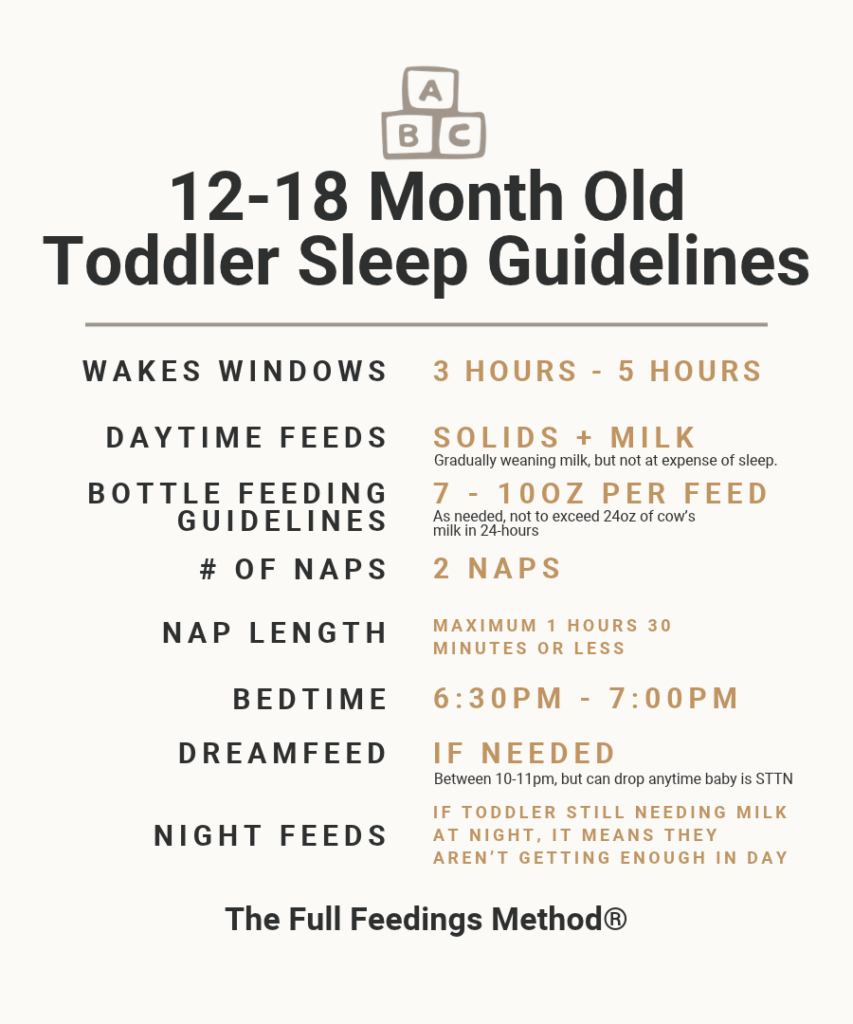
Remember, these are general guidelines—not rigid rules. Your toddler’s sleep and nutritional needs will continue changing throughout this stage.
The goal is to gradually adjust daytime sleep and feeding while protecting consistent nighttime sleep.
 Ready for better toddler sleep?
From 12 months through 4 years, The Full Feedings Method® Toddler Sleep Program helps you navigate changing wake windows, nap schedules, bedtime struggles, and night wakings with age-appropriate guidance.
No cry-it-out. Just a responsive approach to healthy, consistent sleep.


What Changes Between 12 and 18 Months?
Probably less than you think.
One of the biggest surprises for parents is realizing that toddlerhood isn’t made up of dramatic monthly changes.
Unlike infancy, where your baby’s schedule seems to change every few weeks, the second year is much more gradual.
Your toddler doesn’t suddenly wake up on their first birthday needing one nap.
They don’t suddenly stop needing milk.
They don’t suddenly become ready to drink from a cup, eat every food on their plate, and sleep perfectly every night.
Instead, you’ll likely make small adjustments over many months.
Wake windows become a little longer.
Daytime sleep slowly decreases.
Nap #1 often becomes shorter.
Meals gradually replace more milk feedings.
Eventually, many toddlers become ready for one nap.
These changes happen over time — not overnight.
Whenever parents ask me what they should change after their child’s first birthday, my answer is usually the same: If your toddler is sleeping well, eating well, and thriving, there may not be much you need to change at all.
Sometimes the best thing you can do is continue supporting the routine that’s already working.
12 Month Old Sleep
Turning one doesn’t suddenly change your toddler’s biological sleep needs.
Most 12 month olds still thrive with two naps, a consistent bedtime, and a predictable daily routine.
This is also when many families begin thinking about transitions.
Should we stop bottles?
Should we switch from breast milk or formula?
Should we start cow’s milk?
Should we push one nap?
While these transitions may begin during this stage, they rarely need to happen all at once.
In fact, trying to change everything at the same time can create unnecessary stress for both you and your toddler.
If your child is sleeping well with two naps, there’s usually no reason to rush the transition to one.
If milk is still an important source of nutrition, there’s no need to remove it simply because your toddler had a birthday.
Healthy toddler sleep is built on gradual change—not arbitrary deadlines.
13 Month Old Sleep
At 13 months, your toddler may seem dramatically different from just a few months ago.
They’re exploring constantly, communicating more, testing boundaries, and becoming increasingly interested in the world around them.
Not surprisingly, they may also become a little more resistant to sleep.
Many parents assume that fighting a nap means their toddler no longer needs it.
Often, that’s not the case.
Toddlers at this age frequently resist sleep because they would rather keep playing—not because they’re ready to eliminate a nap.
Before making major schedule changes, look at the whole picture.
Is your toddler sleeping well overnight?
Are they eating enough during the day?
Has anything else changed recently?
Sometimes protecting the routine — not changing it — is exactly what your toddler needs.
14 Month Old Sleep
By 14 months, many toddlers continue following a very similar routine.
The biggest difference is often that they need a little more time to settle before sleep.
They’re becoming more aware, more social, and more easily distracted.
This doesn’t necessarily mean they need less sleep.
It may simply mean they need a little more help winding down before naps and bedtime.
Before assuming it’s time for one nap, ask whether your toddler truly needs less sleep—or whether they simply need a smoother transition into it.
Small adjustments often solve what dramatic schedule changes cannot.
15 Month Old Sleep
At 15 months old, many toddlers are still doing very well with two naps.
This is often the age when parents begin questioning whether their child is ready for one nap because bedtime has become a little more challenging or one nap is occasionally refused.
But before making a major schedule change, take a step back and look at the bigger picture.
Has your toddler recently learned to walk or started talking more?
Are they teething?
Has daycare changed their routine?
Have you recently transitioned away from breast milk or formula?
Has their milk intake changed?
Is bedtime becoming later?
Toddlers go through tremendous developmental changes during the second year of life, and those changes can temporarily affect sleep without meaning they need an entirely different schedule.
Sometimes what looks like readiness for one nap is actually your toddler asking for a small adjustment — not a major transition.
16 Month Old Sleep
At 16 months, your toddler may seem caught between two stages.
Some days they happily take two naps.
Other days they resist one altogether.
This can leave parents wondering whether it’s finally time to make the switch.
The truth is, sleep transitions are rarely linear.
Your toddler doesn’t wake up one morning suddenly ready for one nap forever.
There may be days when two naps still work beautifully and other days when one nap seems like the better option.
That’s perfectly normal.
Rather than feeling pressured to choose one schedule immediately, give your toddler time.
Sleep transitions are often much smoother when they’re allowed to happen gradually.
17 Month Old Sleep
By 17 months, many toddlers begin showing more consistent signs that they’re approaching the one-nap transition.
You may notice they’re taking longer to fall asleep, resisting one nap more frequently, or comfortably staying awake for longer periods.
But remember — those signs should be consistent.
One difficult nap doesn’t necessarily mean it’s time to eliminate it.
Teething, illness, travel, developmental leaps, separation anxiety, or even an exciting day can temporarily affect your toddler’s sleep.
If two naps are still supporting good nighttime sleep, don’t feel pressured to change something that’s working.
18 Month Old Sleep
Around 18 months, many toddlers are developmentally ready to begin transitioning to one nap.
Notice I said begin.
Some toddlers make the transition quickly.
Others alternate between one- and two-nap days for several weeks — or even months.
That can be completely normal.
If your toddler has an unusually early wake-up, a poor night’s sleep, is recovering from illness, or simply seems exhausted, don’t be afraid to offer two naps when needed.
Toddler sleep isn’t all-or-nothing.
Flexibility during this transition often helps protect nighttime sleep while your toddler adjusts.
The goal isn’t to get to one nap as quickly as possible.
The goal is helping your toddler get the restorative sleep they need while gradually adapting to a new routine.
Why We Don’t Rush to One Nap
One of the biggest misconceptions about toddler sleep is that turning one means it’s time to transition to one nap.
For many toddlers, that’s simply not true.
At Full Feedings®, we don’t believe birthdays determine sleep needs.
Development does.
Many toddlers continue sleeping beautifully with two naps well into the second year of life. Rather than rushing the transition simply because your child reached a certain age, we encourage parents to watch their toddler — not the calendar.
A toddler who can stay awake longer isn’t always a toddler who should stay awake longer.
There’s an important difference between what a child is capable of doing and what best supports healthy sleep.
Stretching wake windows too quickly can leave some toddlers overtired, making naps shorter, bedtime more difficult, and nighttime sleep less restorative.
If two naps are still working, protect them.
There’s no prize for dropping a nap early.
Why Nap #1 Often Gets Shorter
When toddlers begin showing signs that their sleep needs are changing, many parents assume they should eliminate a nap.
We often take a different approach.
Instead of dropping a nap immediately, we gradually shorten the first nap while protecting the second.
Why?
Because the second nap is often the more restorative nap of the day.
A slightly shorter morning nap allows your toddler to build enough sleep pressure for a quality afternoon nap without becoming overtired before bedtime.
Think of the first nap as a bridge.
Its job isn’t necessarily to provide the longest stretch of daytime sleep.
Its job is to help your toddler comfortably make it to the second nap.
This gradual approach often allows toddlers to continue benefiting from two naps until they’re truly ready for one, rather than transitioning months too early.
Sometimes the smallest adjustments make the biggest difference.
How Long Should a 12–18 Month Old Stay Awake?
As toddlers grow, they naturally become capable of staying awake for longer periods.
But longer isn’t always better.
A wake window isn’t simply playtime.
It includes everything your toddler does while they’re awake:
- ✔️ Eating meals and snacks
- ✔️ Drinking milk
- ✔️ Playing
- ✔️ Reading books
- ✔️ Exploring outdoors
- ✔️ Learning new skills
- ✔️ Running errands
- ✔️ Bath time
- ✔️ Your bedtime or nap routine
- ✔️ The time it takes to actually fall asleep
One thing many parents notice during toddlerhood is that falling asleep often takes a little longer than it did during infancy.
That’s completely normal.
Your toddler is more aware of the world around them and often needs additional time to unwind before sleep.
Rather than immediately extending wake windows, consider beginning your nap or bedtime routine a little earlier so your toddler has enough time to settle before falling asleep.
How Much Daytime Sleep Does a Toddler Need?
Daytime sleep gradually changes throughout the second year of life.
Instead of disappearing overnight, it slowly decreases as your toddler matures.
Some toddlers naturally begin sleeping a little less during the day.
Others continue needing more daytime sleep for quite some time.
Neither is inherently right or wrong.
Rather than comparing your toddler to another child the same age, pay attention to how they’re functioning.
Are they waking happy?
Sleeping well overnight?
Managing their wake windows comfortably?
Growing and developing as expected?
Those answers often tell you much more than the clock ever will.
The goal isn’t to eliminate daytime sleep as quickly as possible.
The goal is to provide enough restorative sleep during the day to support healthy development while protecting consistent nighttime sleep.

 Fighting naps, bedtime, or night wakings?
Your toddler’s sleep needs are constantly changing — but figuring out what to adjust shouldn’t be a guessing game.
The Full Feedings® Toddler Sleep Program gives you step-by-step guidance for naps, wake windows, bedtime, and nighttime sleep from 12 months through 4 years.
Milk Still Matters After Age One
One of the biggest misconceptions about toddlerhood is that milk suddenly becomes unimportant after your child’s first birthday.
It doesn’t.
While solid foods gradually become a larger part of your toddler’s diet, many toddlers continue to rely on milk as an important source of nutrition during the second year of life.
Some toddlers eagerly eat three meals and multiple snacks each day.
Others are still learning to enjoy a wide variety of foods and continue getting a meaningful portion of their nutrition from milk.
Both can be completely normal.
At Full Feedings®, we don’t believe your toddler should stop drinking milk simply because they turned one. Instead, we encourage families to gradually transition as their toddler becomes developmentally and nutritionally ready.
Like every other milestone during toddlerhood, there is no rush.
Transitioning from Breast Milk or Formula
After your toddler’s first birthday, you may begin thinking about transitioning away from breast milk or formula.
Notice I said begin.
This doesn’t have to happen overnight.
Some toddlers transition easily.
Others need much more time.
Both are perfectly normal.
One of the biggest mistakes I see is parents trying to make every transition at once.
They switch to cow’s milk.
They throw away the bottles.
They introduce cups.
They push more solids.
They start one nap.
That’s a tremendous amount of change for one little person.
Instead, think of toddlerhood as a season of gradual transitions.
You don’t have to change everything at once.
Small, successful changes are almost always easier than several major changes happening together.
Transitioning from a Bottle to a Cup
Parents often ask me:
“Should I stop breast milk or formula first, or should I get rid of the bottle first?”
There isn’t one correct answer.
These are actually two separate transitions.
Some toddlers do well transitioning to cow’s milk while continuing to drink from a bottle for a little while longer.
Others are perfectly happy learning to drink from a straw cup while continuing breast milk or formula.
The order matters much less than your toddler’s comfort.
If one transition is going smoothly, give your toddler time to adjust before introducing another.
There’s no benefit to overwhelming them with multiple changes all at once.
There Is No Rush to Remove Milk
Turning one doesn’t suddenly mean your toddler no longer needs milk.
It simply means solid foods gradually become a larger part of the picture.
Some toddlers naturally begin eating larger meals soon after their first birthday.
Others continue relying on milk while they build confidence with solids.
Rather than comparing your toddler to another child, pay attention to your own.
Are they growing well?
Are they energetic?
Are they sleeping well?
Are they gradually expanding the foods they’ll eat?
If so, you’re likely moving in the right direction.
Toddlerhood isn’t about checking milestones off a list.
It’s about supporting your child’s individual development.
How Much Cow’s Milk Should a Toddler Drink?
Once your toddler transitions to cow’s milk, it’s generally recommended that intake not exceed 24 ounces per day.
Too much cow’s milk may reduce your toddler’s appetite for other foods and, in some children, can contribute to low iron intake.
If your toddler still seems to need more milk than that, talk with your pediatrician.
Some families choose to supplement with a milk alternative rather than exceeding the recommended amount of cow’s milk.
The best choice depends on your toddler’s overall nutrition, growth, allergies, and individual needs.
What If My Toddler Still Wants Lots of Milk?
That can be completely normal.
Toddlers don’t all become adventurous eaters overnight.
Some happily eat almost anything.
Others need much longer to explore new textures, flavors, and foods.
Appetites also change from week to week.
Teething.
Illness.
Travel.
Growth spurts.
Developmental leaps.
All of these can temporarily affect how much your toddler wants to eat.
Instead of forcing solids or abruptly removing milk, continue offering balanced meals and snacks while allowing your toddler to develop at their own pace.
Progress is rarely perfectly linear.
What If Removing Milk Causes Night Wakings?
This is one of the biggest clues I encourage parents to pay attention to.
If you remove milk during the day…
…and your toddler suddenly starts asking for milk overnight…
your toddler may simply be telling you they still need those calories.
Rather than assuming you’ve created a sleep problem, ask yourself whether you’ve created a calorie problem.
Those calories didn’t disappear.
They simply shifted from daytime to nighttime.
If your toddler begins waking overnight for milk after you remove a daytime milk feed, it may be worth slowing the transition down.
Sometimes restoring that daytime milk allows nighttime sleep to naturally improve again.
There’s no benefit to removing milk during the day only to have your toddler ask for it again at two o’clock in the morning.
If your toddler is genuinely hungry overnight, they should always be fed.
Solids First or Milk First?
Another common question I hear is:
“Should my toddler eat solids before drinking milk?”
As toddlers become more interested in food, many families naturally begin offering meals before milk.
But this doesn’t need to happen overnight.
If your toddler still relies on milk to feel full, it’s okay to move more gradually.
Whenever you make a feeding change, pay attention to the whole picture.
Ask yourself:
- ✔️ Is my toddler eating enough throughout the day?
- ✔️ Did nighttime sleep change after we reduced milk?
- ✔️ Are they waking hungry overnight?
- ✔️ Are they still growing and thriving?
Those answers are often more helpful than following a rigid timeline.
Daycare and Toddler Sleep
Starting daycare — or moving into a new classroom — can bring new sleep challenges.
Your toddler’s daycare schedule may not perfectly match the routine you’d choose at home.
They may be expected to nap at a different time.
Some classrooms transition children to one nap earlier than they’re truly ready.
Other days, your toddler may simply be too excited to sleep well.
That’s okay.
Rather than striving for the perfect schedule every day, focus on consistency where you have control.
On weekends and days at home, continue following an age-appropriate routine.
If daycare results in a shorter nap or an earlier wake-up, your toddler may simply benefit from an earlier bedtime that evening.
Remember, healthy sleep is built over weeks and months—not determined by one difficult nap.
When Is My Toddler Ready for One Nap?
One of the most common questions parents ask during the second year of life is:
“How do I know when it’s actually time to transition to one nap?”
While many toddlers begin making the transition around 18 months, age alone shouldn’t determine when you make the change.
Instead, look for a consistent pattern.
Your toddler may be ready if they regularly:
- ✔️ Resist one of their naps despite a consistent routine.
- ✔️ Comfortably stay awake for longer periods without becoming overtired.
- ✔️ Take one long, restorative midday nap.
- ✔️ Continue sleeping well overnight.
- ✔️ Wake happy and well-rested.
Just as importantly, ask yourself what isn’t happening.
One difficult nap.
One skipped nap.
One rough bedtime.
One early morning.
Those aren’t enough to conclude your toddler is ready for a completely different schedule.
Developmental leaps, teething, illness, travel, excitement, and changes in routine can all temporarily affect sleep.
When in doubt, give your toddler time.
There’s rarely a downside to waiting a little longer, but transitioning too early can often create unnecessary overtiredness.
How to Transition to One Nap
Once your toddler consistently shows they’re ready, the transition to one nap can happen gradually.
Remember, this isn’t a race.
Some toddlers move comfortably to one nap over a few weeks.
Others benefit from alternating between one- and two-nap days for a while.
That’s completely normal.
During the transition:
- ✔️ Move slowly.
- ✔️ Watch your toddler — not the calendar.
- ✔️ Expect some flexibility.
- ✔️ Use an earlier bedtime when needed.
- ✔️ Remember that occasional two-nap days are perfectly okay after illness, travel, daycare, or an unusually early morning.
The goal isn’t a perfect schedule.
The goal is helping your toddler continue getting the restorative sleep they need while their body adjusts.
Not sure when your toddler is ready for one nap?
Transitioning too early can lead to over tiredness, bedtime battles, and disrupted nights.
The Full Feedings Method® Toddler Sleep Program helps you understand when to make changes, how to adjust naps gradually, and how to protect nighttime sleep as your toddler grows.
Common Toddler Sleep Challenges
My toddler suddenly refuses naps.
Before assuming your toddler is ready for one nap, consider whether they’re simply more aware of the world around them. Toddlers often need more time to settle before sleep than they did during infancy.
My toddler fights bedtime.
Bedtime resistance isn’t always caused by too much energy.
Sometimes it’s caused by overtiredness, hunger, changes in daytime sleep, developmental milestones, or inconsistent routines.
Looking at the entire day often provides more answers than focusing only on bedtime.
My toddler is waking up earlier than usual.
Early morning waking can have many causes, including changes in daytime sleep, bedtime timing, hunger, illness, or developmental changes.
If your toddler recently reduced their daytime milk intake and is suddenly waking hungry, that connection is worth paying attention to.
My toddler started waking overnight again.
Toddlers don’t suddenly “forget” how to sleep.
Ask yourself what has changed recently.
Did you transition to one nap?
Reduce daytime milk?
Start daycare?
Travel?
Move bedtime?
Often, the answer is found somewhere in the previous 12 hours.
 Frequently Asked Questions
What is a good sleep schedule for a 12–18 month old?
A healthy 12–18 month sleep schedule usually includes two naps for much of this stage, gradually lengthening wake windows, consistent meals and milk, and a predictable bedtime. Most toddlers transition to one nap gradually rather than overnight.
Should my 12 month old still take two naps?
Yes. Most 12 month olds continue benefiting from two naps. Turning one doesn’t automatically mean your toddler is ready for one nap.
Should my 15 month old still take two naps?
Many 15 month olds still sleep very well with two naps. Before dropping a nap, consider whether a small adjustment to the schedule might be all your toddler needs.
Is my 18 month old ready for one nap?
Many toddlers begin transitioning around 18 months, but readiness varies. Some continue benefiting from two naps or alternating between one- and two-nap days during the transition.
How do I know when my toddler is ready for one nap?
Look for a consistent pattern of nap resistance, comfortably staying awake for longer periods, taking one restorative midday nap, and continuing to sleep well overnight.
How much sleep does a 12–18 month old need?
Sleep needs vary from child to child, but toddlers still need a significant amount of restorative sleep during both the day and night to support healthy growth and development.
Why is my toddler suddenly fighting naps?
Nap resistance can be caused by developmental changes, teething, illness, separation anxiety, needing more time to settle, or schedule adjustments. It doesn’t always mean your toddler is ready to eliminate a nap.
Why is my toddler fighting bedtime?
Bedtime struggles can be related to daytime sleep, over tiredness, hunger, developmental milestones, or changes in routine. Looking at the entire day often provides valuable clues.
Does my toddler need to stop drinking milk after age one?
No. Many toddlers continue benefiting from milk after their first birthday while they gradually transition to eating more solid foods. Talk to your pediatrician about daytime maximums for cow’s milk (typically 24oz max)
Is there a rush to stop bottles?
No. Transitioning away from breast milk or formula and transitioning away from bottles are separate milestones. Many families find it easier to make one change at a time.
How much cow's milk should a toddler drink?
Cow’s milk should generally not exceed 24 ounces per day. Speak with your pediatrician if you have questions about your toddler’s nutritional needs.
Can my toddler have a milk alternative instead?
Some families choose to supplement with a milk alternative rather than exceeding the recommended amount of cow’s milk. Your pediatrician can help you determine the best choice for your child.
What if removing milk causes my toddler to wake at night?
If daytime milk disappears and your toddler suddenly begins waking overnight for milk, they may still need those calories. Consider slowing the transition and discussing your concerns with your pediatrician if needed.
Should solids replace milk immediately?
No. This transition happens gradually. Many toddlers continue relying on milk while they become more comfortable eating a wider variety of solid foods.
Can my toddler alternate between one nap and two naps?
Absolutely. Many toddlers alternate between one- and two-nap days during the transition, especially after illness, travel, daycare, or an unusually early morning.
Does daycare mean my toddler has to switch to one nap?
Not necessarily. Daycare schedules don’t always reflect your toddler’s individual readiness. Continue supporting an age-appropriate routine at home whenever possible.
Is the 12 month sleep regression real?
Many toddlers experience sleep changes around their first birthday, but those changes are often related to development, feeding transitions, increased mobility, and schedule changes — not simply because they turned one.
Final Thoughts
The second year of life is filled with exciting milestones.
First steps.
First words.
New foods.
Growing independence.
And eventually, the transition from two naps to one.
But none of those milestones have to happen overnight.
If there’s one thing I hope you take away from this guide, it’s this:
There is no rush.
Your toddler doesn’t earn extra points for dropping a nap early.
They don’t need to stop drinking milk the day they turn one.
They don’t have to give up bottles, master cups, transition to one nap, and suddenly become a perfect eater all at the same time.
Healthy sleep isn’t built by chasing milestones.
It’s built by paying attention to your child.
If two naps are working, protect them.
If milk is still supporting your toddler’s nutrition, don’t feel pressured to remove it overnight.
If a daytime milk transition suddenly creates nighttime hunger, listen to what your toddler is telling you.
Sometimes slowing down is exactly what they need.
At Full Feedings®, we believe responsive parenting doesn’t end after infancy.
As your child grows, we’ll help you continue making thoughtful, age-appropriate adjustments that support healthy sleep, healthy nutrition, and a confident, well-rested family.

