
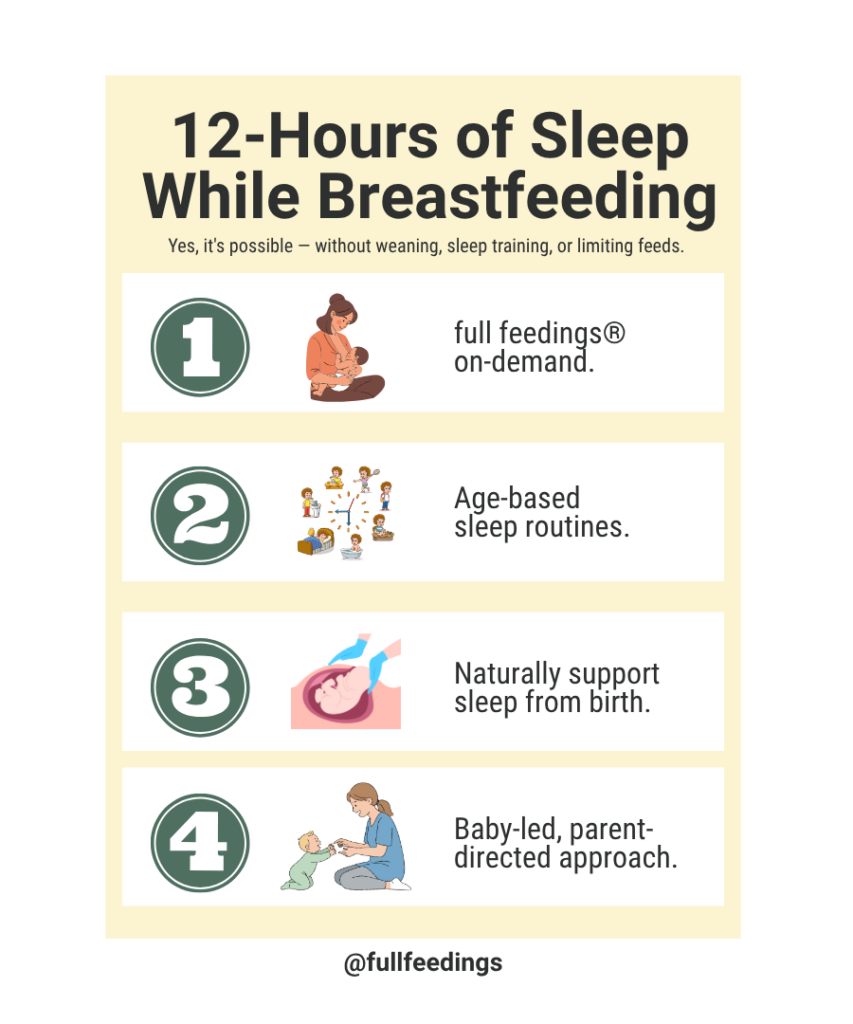
12-Hours of Sleep While Breastfeeding

The short answer: Yes, it is possible for many breastfed babies to eventually sleep 12 hours overnight while still getting enough milk, growing well, and maintaining a healthy breastfeeding relationship. The goal is not to withhold food, skip needed feeds, or force sleep. The goal is to support full feedings®, protect total daily intake, use a dreamfeed when appropriate, and support milk supply if a nursing session is replaced with a bottle or pump session.
Here’s why this matters: There is a lot of misinformation around breastfeeding and sleep. Many nursing parents are told that their baby must continue waking overnight to nurse in order to maintain milk supply, but that is not always true. Breastfeeding, milk supply, and longer nighttime sleep can work together when your baby is feeding fully, gaining appropriately, and getting enough milk in 24 hours.
Can You Really Get 12 Hours of Sleep While Breastfeeding?
Yes, many breastfeeding families can eventually get 12 hours of overnight sleep while continuing to breastfeed.
That does not mean every breastfed baby will sleep 12 hours at the same age. It also does not mean night feeds are wrong. Night feeds are normal and necessary for many babies, especially newborns and younger infants.
But it does mean breastfeeding parents do not have to assume that waking all night is required simply because their baby is breastfed.
A breastfed baby is more likely to sleep longer stretches when they are:
✔️ getting enough milk in 24 hours
✔️ taking full feedings® during the day
✔️ growing and gaining weight appropriately
✔️ having normal diaper output
✔️ not waking from true hunger overnight
✔️ following an age-appropriate routine
✔️ using a dreamfeed when appropriate
The goal is not to make a hungry baby sleep. The goal is to help your baby get enough milk during the day and evening so they do not need to make up missed calories overnight.
Will Sleeping Through the Night Hurt Milk Supply?
Sleeping through the night does not automatically hurt breast milk supply.
Breast milk production works on supply and demand. If milk is regularly removed, your body receives the signal to keep making milk. If your baby is eating from a bottle instead of nursing, pumping around that feeding helps protect supply because your body still receives the message that milk is needed.
This is where many parents get confused.
The concern is not necessarily that your baby sleeps longer. The concern is whether your baby’s total intake and your milk removal are still being supported.
If your baby is growing well, taking full feeds during the day, and your supply is being supported appropriately, longer sleep stretches may be possible without ending breastfeeding.
Some nursing parents also choose to pump before bed, even after the baby no longer needs a dreamfeed. This can help protect supply, build a freezer stash, or shorten the stretch of time the body goes without milk removal overnight.
At full feedings®, we never recommend withholding food from a hungry baby. We never recommend skipping needed feeds to force sleep. Instead, we focus on helping babies take full feeds during the day so longer overnight stretches can happen naturally when the baby is developmentally ready.
Breastfeeding and sleep do not have to work against each other. With the right feeding rhythm, supply support, and age-appropriate routine, many families are able to protect breastfeeding while also moving toward consistent nighttime sleep.
We Do Not Withhold Food to Force Sleep
This is important:
We do not withhold food from a hungry baby.
We do not withhold food to force sleep.
We do not ignore hunger cues day or night.
The Full Feedings Method® is not about feeding less. It is about helping babies feed more fully.
If your baby is hungry overnight, they should be fed. But if your baby is waking frequently because daytime feeds are short, sleepy, distracted, or incomplete, then the solution may be improving daytime intake rather than assuming your baby must continue waking all night.
Hungry babies do not sleep well. Fully fed babies often sleep more predictably.
What Are full feedings® for Breastfed Babies?
A full feeding® for a breastfed baby means your baby nurses long enough and effectively enough to stay satisfied until the next feed.
For young babies, a full feeding often takes about 30 minutes total, including burp time. This does not mean forcing a baby to nurse. It means supporting the feed so your baby can stay awake, comfortable, and engaged long enough to eat well.
A full breastfeeding session may include:
✔️ burping often
✔️ switching sides
✔️ taking short breaks
✔️ adjusting position
✔️ keeping baby awake during daytime feeds
✔️ offering feeds frequently during the day
✔️ watching hunger and fullness cues
Feeding is not always passive. Babies often need help staying awake and comfortable enough to finish a full feed. Sometimes a short break, a burp, or a position change helps them come back to the breast and realize they are still hungry.
The goal is not to force milk. The goal is to help your baby feed fully.
Why Daytime Breastfeeding Affects Nighttime Sleep
Night sleep is closely connected to daytime intake.
If a breastfed baby takes small, sleepy, or incomplete feeds during the day, they may need to make up those calories overnight. This can create a cycle of frequent night waking, short feeds, and daytime snacking.
When full feedings® are prioritized during the day, babies are more likely to get the milk they need before bedtime.
That can help:
✔️ reduce unnecessary overnight waking
✔️ support longer sleep stretches
✔️ protect growth and weight gain
✔️ reduce snacking
✔️ support a more predictable routine
✔️ help night feeds naturally decrease when baby is ready
This is why breastfeeding and sleep need to be viewed together. If a baby is not getting enough full feeds during the day, sleep may continue to feel unpredictable.
 Breastfeeding & Sleep can work together.
Our Infant Sleep Program walks you through full feedings®, dreamfeeds, wake windows, naps, bedtime, night feeds, and no cry-it-out sleep support — so your baby can get the intake they need and sleep more consistently.
What Is a Dreamfeed for a Breastfed Baby?
A dreamfeed is a late evening feed, typically offered between 10:00pm and 11:00pm, while your baby is still sleepy or mostly asleep.
For breastfed babies, a dreamfeed can be very helpful because it gives baby one more full feeding before their longest overnight stretch. This can help prevent hunger from waking them earlier in the night.
Some families nurse the dreamfeed. Others offer a bottle of pumped milk so another caregiver can help and the nursing parent can get a longer stretch of sleep.
If a bottle replaces a nursing session, pumping around that time helps protect supply.
At full feedings®, the dreamfeed is not meant to be a tiny top-off. It should still be treated as a full feeding.
We usually recommend keeping the dreamfeed in place until your baby is consistently sleeping through the night and developmentally ready to go from bedtime to morning without needing to eat.
Do You Need to Pump if Your Breastfed Baby Takes a Bottle?
If your baby receives a bottle instead of nursing, it is usually important to pump around that feeding.
This matters because breastfeeding is supply and demand. If your baby is eating, your body needs milk removal or stimulation around that same general time so it knows milk is still needed.
For example, if another caregiver gives a bottle for the dreamfeed, the nursing parent may pump before bed or around that same feeding window.
This can help:
✔️ protect milk supply
✔️ replace the missed nursing session
✔️ provide milk for future bottles
✔️ support a freezer stash
✔️ allow another caregiver to help with feeds
✔️ give the nursing parent a longer sleep stretch
The exact plan can vary by family, but the principle is the same: if baby is eating and you are not nursing, your body usually still needs the signal.
Can You Maintain Milk Supply While Baby Sleeps Longer?
Yes, many parents can maintain milk supply while baby sleeps longer, but the details matter.
Supply is best supported when:
✔️ baby gets full feeds during the day
✔️ baby’s total daily intake is protected
✔️ missed nursing sessions are replaced with pumping when needed
✔️ baby is growing and gaining appropriately
✔️ feeds are not being skipped before baby is ready
✔️ the nursing parent is also getting enough rest
Adequate sleep matters for the nursing parent too. Prolonged sleep deprivation is not helpful for breastfeeding, recovery, mental health, or family functioning.
Breastfeeding support should not assume that the nursing parent must be exhausted indefinitely.
What If My Baby Still Needs Night Feeds?
That is okay.
Night feeds are normal for many babies. If your baby is hungry, feed them.
The goal is not to remove night feeds before your baby is ready. The goal is to make sure every feed — daytime, dreamfeed, and night feed — is as full and effective as possible.
Night feeds should be full feedings® too.
If a baby wakes at night and only takes a small snack, they may wake again soon. A full night feed helps your baby get the milk they need and can prevent repeated short overnight feeds.
Over time, as daytime intake improves and your baby becomes developmentally ready, night feeds may naturally reduce.
How full feedings® Support Breastfeeding and Sleep
The Full Feedings Method® supports breastfeeding and sleep by focusing on the full picture:
✔️ full feeds
✔️ frequent daytime intake
✔️ age-appropriate wake time
✔️ dreamfeeds when appropriate
✔️ supply support when bottles are used
✔️ responsive feeding
✔️ a baby-led, parent-directed routine
✔️ no cry-it-out sleep support
This method does not ask parents to ignore hunger. It asks parents to look at whether baby is truly getting complete feeds during the day.
When babies are fully fed, well-rested, and supported with an age-appropriate routine, sleep can often improve without forcing it.


Signs Your Breastfed Baby May Not Be Taking Full Feeds
Your baby may be struggling with full feedings® if they:
✔️ feed for only a few minutes at a time
✔️ fall asleep quickly at the breast
✔️ wake very soon after a feed
✔️ need constant top-offs
✔️ feed every 30 to 90 minutes all day
✔️ wake frequently overnight to eat
✔️ seem unsatisfied after feeds
✔️ struggle to stay awake while nursing
✔️ do not seem to stretch comfortably between feeds
These signs do not mean you are doing anything wrong. They simply mean your baby may need more support staying awake, burping, switching sides, or organizing feeds into a more complete rhythm.
Tips to Help a Breastfed Baby Take Full Feedings
To encourage full feedings® while breastfeeding, try:
✔️ feeding in a bright room during the day
✔️ undressing baby slightly if they are sleepy
✔️ changing the diaper mid-feed
✔️ burping often
✔️ switching sides
✔️ using breast compressions if appropriate
✔️ taking short breaks
✔️ adjusting position
✔️ keeping baby awake and engaged
✔️ offering feeds frequently during the day
✔️ following an age-appropriate routine
These small adjustments can help your baby take a more complete feed without forcing intake.
Can Breastfeeding Parents Get More Sleep?
Yes. Breastfeeding parents can often get more sleep when feeds are organized in a way that supports both supply and baby’s intake.
This may include:
✔️ using a dreamfeed
✔️ pumping when a bottle replaces nursing
✔️ having another caregiver offer pumped milk
✔️ protecting full daytime feeds
✔️ avoiding short, frequent snacks when possible
✔️ supporting baby’s routine before overtiredness sets in
Breastfeeding does not have to mean one parent is awake all night forever.
The goal is to support the baby’s biological needs and the nursing parent’s need for rest.
 Want help protecting breastfeeding & sleep?
The Full Feedings Method® teaches you how to support full feeds, milk supply, dreamfeeds, night feeds, wake windows, naps, and consistent nighttime sleep — without cry it out. And we have options for email support with lactation consultants, too!
Final Thoughts
A breastfed baby can sleep longer stretches — and eventually 12 hours overnight — while still getting enough milk and maintaining a healthy breastfeeding relationship.
The key is not withholding food. The key is full feedings®.
When babies feed fully and frequently during the day, use a dreamfeed when appropriate, and receive full feeds overnight when they are truly hungry, sleep can begin to consolidate naturally.
Breastfeeding, milk supply, and sleep can work together.
You do not have to choose between nursing your baby and getting rest.
Need help with breastfeeding and sleep? Our affordable online programs teach breastfeeding basics, bottle feeding basics, and no cry-it-out infant and toddler sleep through The Full Feedings Method®.
Questions? Reach out anytime at [email protected]. We’d love to hear from you.

